The excellent CatholicYouthWork.com shared an article from Youthwork Magazine, in which a Christian youth minister shares an open letter to students everywhere:
Dear young people,
This letter is written with nothing but love and respect for you. We've entered exam season. I remember well the stress and tension, the constant reminders from teachers that 'these are the most important exams you'll ever take' and the feeling that you are going to do nothing but spend the next three months of your life revising.
I wanted to write to you to try and speak some different words into your life. In this time of stress and tension I wanted you to hear some other messages apart from 'revise, revise, revise!' and that feeling that your future success and achievements are all based on getting straight A*s.
This isn't about detracting from the importance of exams, or going against what your teachers are saying! These exams are important, revision is necessary, but what I'm trying to say is that there is more to life:
Firstly, before you take your exams, remember this simple fact - you are amazing. You have gifts, talents and abilities that are unique to you. You have something to offer to this world, something that cannot be taken away, or added to, by these exams. Please remember that. Your worth, your value, in God's eyes is not affected by your performance over these next few months. He already thinks you are amazing.
Secondly - and I say this without any intent of guilt - please don't give up on church. Whether that's Sunday services, house groups, youth groups - whatever and wherever it is that you connect with God, please don't give up on it. Right now, in this intense period of your life you need God more than ever, and you need the support of those around you - to pray for you, to support you. You also need times of fun, times of laughter, times of complete relaxation to not only enjoy yourself but also to help your brain process what you've been revising.
I understand that you may not be able to come every week, or to every session but please don't disappear until your last exam has finished. We want to help you, care for you and pray with you. Also, when your exams have finished - please come back! Don't think that not being able to come all the time means you can never return - we want to hang out with you, to celebrate the achievement of finishing your exams with you!
Finally - don't forget your personal faith. Your own Bible time and times of personal worship are equally important at this time. It's vital that you find time to speak to God, to give him your concerns, your worries and your fears and also receive from him - his hope, his strength, his love.
So please, remember God, remember us, and I hope we will see you soon.
(Article found here. This was written by Nick Francis who is "a youth minister in a Methodist, URC & Baptist LEP church in Buckingham. He is married with two kids, is a bit of a geek and if he wasn't landlocked would love to surf every day.")
I would also obviously recommend a prayer to Saint Joseph of Cupertino (the flying Saint!) who you can read about here.
Loving God, be with me now, as I prepare for my exams. Thank you for the many talents and gifts you have given me and for the opportunity of education. Calm my nerves and anxiety, help me to remember all that I have studied, to express it clearly and to answer the questions the very best that I can. Holy Spirit, sit with me in my exam - and always. In Jesus' name Amen
Matthew Huish, a Unification church pastor also shares this advice:
"I would encourage a student to pray like this at the start of the exams: “Heavenly Father, I’ve been working for months to prepare for this exam. This is now my opportunity to make an offering to you by performing well. I hope I can make you (and my parents and teachers) happy by getting the top grade!"
He goes on to give a final piece of advice (I'm not 100% on this one...):
One last word of encouragement: When the exam supervisor announces, “You may now begin the exam,” I advise you to do nothing for 30 seconds. Don’t open the exam booklet. Don’t lift a pen. Don’t even open your eyes. Just sit in calm meditation knowing that you are more important that this exam, remembering that God loves you and you love God, and be aware not just the small exam hall in which you sit in silence but also of your position in the entire cosmos. I always found that it helps me relax and be prepared to perform to the best of my ability (according to my preparation) in that situation.
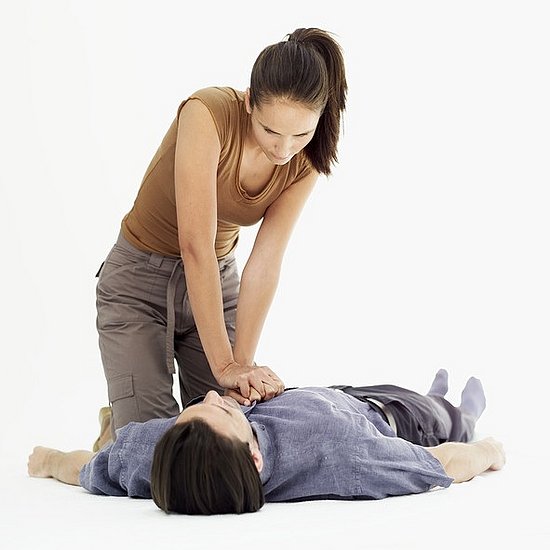
Most people regard cardiac arrest, or having a heart attack, as synonymous with death. However many do survive...
"Doctors have long believed that if someone is without a heartbeat for longer than about 20 minutes, the brain usually suffers irreparable damage. But this can be avoided... with good quality CPR and careful post-resuscitation care.", a BBC article claims.
Dr Sam Parnia, the director of resuscitation research at Stony Brook University in New York, has written a book called the Lazarus Effect. So named after the story in St John's Gospel whereby Jesus brings Lazarus back to life, four days after his funeral (read it here).
However, Parnia is still talking a matter of hours. This is still an incredible length of time after the heart has stopped. In the original article (see below), he speaks of the process of 'cooling' which induces a form of hibernation.
He does think we need to rethink when death begins. Technically hospitals do not declare a person to be dead until everything possible has been tried, however he seems to be suggesting that we maybe need to rethink where this point is.
One story that is cited in the article is this truly amazing one:
A 2011 report in the medical journal Resuscitation describes the case of a 30 year-old unnamed Japanese woman who was discovered dead in the woods at 8.32am. She had been there for several hours and her body temperature was 20 degrees. At hospital she was given adrenaline and hooked up to a special CPR machine. At 2:57pm, her heart restarted. She was discharged three weeks later "with slight left-sided weakness".
How many people would try to save this woman?
Parnia also speaks in the article about his fascination with 'near death experiences', which he claims around 10% of patients who have 'died' have.
Does science mean we need to think more carefully about death? Do you think we need to realise there is a midway point between 'alive' and 'dead'? How does Parnia's interests in NDE effect his view of resuscitation? What other implications are there for health care?
Billy Bragg, the Bard of Barking, has a new album out. The singer-songwriter, famous for his politics as well as his music has released a thoughtful and thoroughly enjoyable album which touches upon religion in a few places. This is a topic Billy has never been particularly outspoken about, but perhaps reveals a universal truth in religion (and humankind), that everyone can appreciate and understand.
The song 'Do Unto Others' is a clearly about 'The Golden Rule' and focus' on the Christian version of this teaching:
In the Bible, we are told God gave Moses the...Ten great commandments whisper true truths! But the greatest commandment of all Is in the book of Lucas, cause I recall Do unto others as you would them do unto you! Do unto others as you would them do unto you!
Now baby you don't believeIn the story of Adam and Eve Who called up on science to prove it's all untrue! But in the cold light of the day Peaceful words still point the way Do unto others as you would them do unto you! Do unto others as you would them do unto you!
So just lift up your eyes, Don't pass by on the other side Don't be about what you think these may do With just a little bit of faith, and that's all it really takes Do unto others as you would them do unto you! Do unto others as you would them do unto you!
Now the way the world is run Too many people looking after number one Don't seem to notice the damage that they do! No, it's not widely understood There is, there is a greater good Do unto others as you would them do unto you! Do unto others as you would them do unto you!
However, it's naive to think that this piece of teaching is only found in Christianity. It's hard to not agree with Billy that it is "the greatest commandment of all" and that despite science's claims and proofs,"peaceful words still point the way". However, many people don't realise that it is actually a key feature of many of the world's religions too (click on the image to enlarge):
To listen to the song, click here:
Do you think there can be such thing as a universal command? Is it important that all humans, regardless of religion try to subscribe to this simple idea of 'Do Unto Others'? Why do you think so many people still 'pass by on the other side'? Are there any occasions when this teaching doesn't work? Does it matter if people are religious or not to use this as their guiding principle?
Support Billy by buying his album: www.BillyBragg.co.uk
A philosopher who is not taking part in discussions is like a boxer who never goes into the ring. ~ Wittgenstein
Philosophy can sometimes get a little heavy. It is one of the oldest academic subjects, and it's tough! It's also incredibly rewarding and the skills learnt are invaluable for all kinds of further education and careers. It's a real skill to enter into philosophical discussion - and even harder to summarise a whole complex idea into 3 minutes. However, many try to do just such a thing. Here are some examples (focussed on EdExcel AS/A2 Philosophy and Ethics syllabus): St Thomas Aquinas:
Last Sunday was Vocations Sunday in the Roman Catholic Church in England and Wales; also known as Good Shepherd Sunday. In 2010, it made the news that vocations were on the rise (Read more here). This was largely reported just after Pope Benedict XVI's visit to the UK. However many suggested that this very visit would have an impact on the Catholics of England and Wales and prompt more young Catholics to consider a vocation to the priesthood or religious life. This seems to have been the case:
"Entry to religious orders has continued to rise in England and Wales during 2012. For the third year running, the number of women entering religious communities has grown and this year has seen a noticeable increase in the number of men joining as well." "Last year also saw the highest number of ordinations to the diocesan priesthood in nearly ten years, with 31 priests ordained for the dioceses of England and Wales." (Read more here)
This looks set to grow with with 41 projected for 2013. This is a rapid increase from just 20 in 2011.
Why do you think that this is happening? Does this indicate a bright future for the Catholic Church in the UK? Is the change in the way young people are encouraged to discren their vocation? Is there better support for those who consider this type of vocation?
The National Office for Vocation is found here: http://www.ukvocation.org They have published a variety of resources for Vocations Sunday here: http://www.ukvocation.org/vocations-sunday-resources GCSE students may also find this site helpful: http://www.calledtoday.com/
This event shocked the world; the joyous celebration of Patriot's Day in the wonderful city of Boston suddenly interrupted by two explosions near the finish line of the Marathon.
I left Boston just last Friday morning and had walked past the scene earlier in the week, commenting on the restaurants offering bookings for the 'prime seats for the finish line'. Our Duck Tour guide told us how excited everyone was about the marathon and showing us where the finishers congregated.
I have blogged before about 'Where was God?' (read my post on the Sandy Hook shooting here) and the sentiments are true of this event. From a Christian point of view, God was most certainly evident in the marathon runners who finished the 26.2mi and carried on running to the local hospital to give blood (see here) or those who ran straight back into the blast area to carry out the wounded, not to mention the emergency services who could not have envisaged such scenes. In answer to some responses to this blog, this is an answer to the question, "If there is a God, where was He?" rather than an outright claim for his existence.
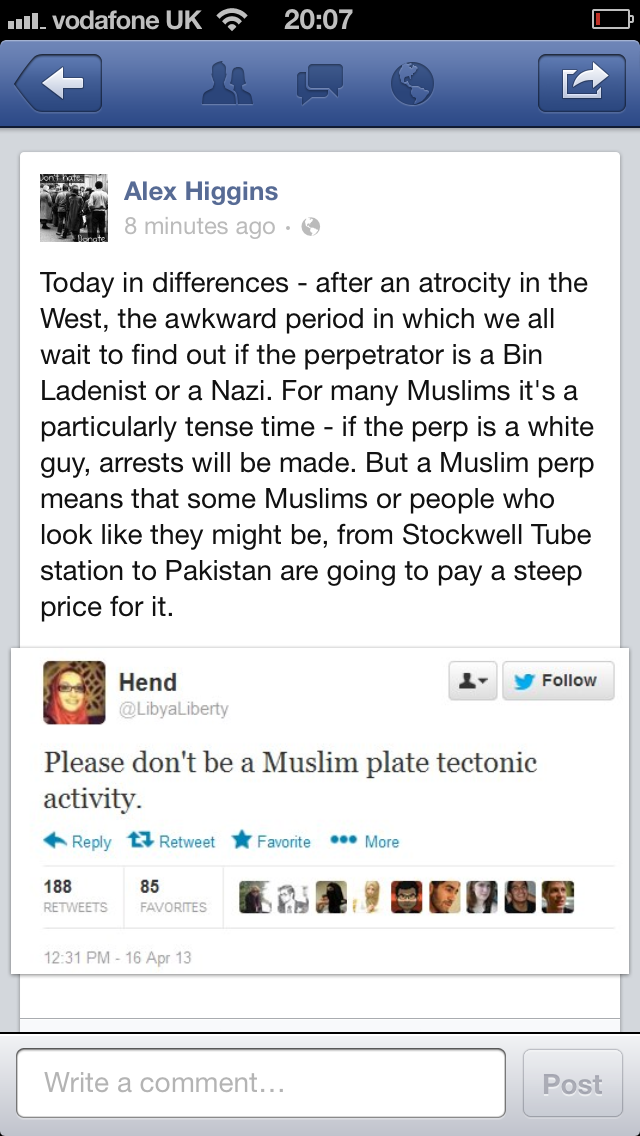
However, very quickly came the blame. Reports flooded Twitter that a Saudi Arabian man had been arrested; blame was almost instantly put on the Muslim community. It was amazing how quickly a large number of the Internet community instantly blamed Islamic terrorists.
The New Yorker have today (17/4/13) blogger about this, since the Saudi man was completly innocent. He was basically arrested and his house searched, his room mate quizzed for 5 hours because he was 'suspicious look'... apparently he was running away from the bomb scene, smelled like explosives (his wounds not being reason enough for this) and he asked if anyone was dead. He was also 'Arab-looking'.
The most powerful part of the blog for me was this, "... people who love him might have had to find out that a bomb had hit him when his name popped up on the Web as a suspect in custody. It is at these moments that we need to be most careful, not least." (The full article is here and well worth a read).
A friend posted this on Facebook, which I thought was very true:
This is the sad opening paragraph from The American Muslim site:
"Like millions of Americans across the nation, my heart dropped at the news of the bombings in Boston. As a mother, I was devastated for those who lost their children. As a spouse, I mourned for those who lost their life partner. And as a Muslim, I admittedly feared for the safety of my children and community from the inevitable backlash that would arise at the mere speculation that the suspect is a Muslim." (read more)
Even if it is discovered that the bomb was the responsiblity of Muslim terrorists, it seems increasingly that many are incapable of distinguisng between ordinary Muslims and these extremists. Fox News pundit Erik Rush Tweeted "Muslims are evil. Let’s kill them all." which caused a huge backlash (read more here). Officials have been very hesitant to blame anyone until more facts are known and certianly reactions like this are far from helpful. It is a clear case of Islamaphobia, an irrational fear of Islam.
The BBC filmed some Boston Muslims talking after the bomb too (watch here).
Other theories are that far-right extremists are involved, using Patriot's Day, Tax Day and links to Boston's history as evidence (more on this here). 9/11 aside, nearly all terrorist attacks on America have been from white, often Christian, Americans.
It is clear that radicalism and fundamentalism must always be challenged and never tolerated. Whether Muslim or Christian, far-right or far-left... we must not divide our communities, especially without good reason.
Now is the time to direct our thoughts and prayers to those who have died, those who are injured and those who are hurting.
My message to the people of Boston who welcomed me so warmly last week, "Rise up, rise up..."
Bruce Springsteen plays "My City of Ruins" at Fenway Park, Boston, in 2012
.jpg)